I've put together a video for You Tube which deconstructs the BBC's reporting of the Anderegg paper.
Showing posts with label climategate. Show all posts
Showing posts with label climategate. Show all posts
Tuesday, 4 January 2011
Thursday, 16 December 2010
More on BBC's woeful reporting of Anderegg
At last I have recieved a response to my complaint about the BBC's reporting of the Anderegg paper. First impressions are this simply doesn't wash. The weasel words are 'based on an interview'. I can point to evidence in the public domain that Doctor Anderegg started work on this paper before the climategate or glaciergate events. Yet in the BBC's version the paper was motivated by events that occurred after work began on the paper. Of course that is impossible. Here is the response from the journalist who compiled the report, complete with spelling mistakes.
Dear Mr McStont
Many thanks for your email and your interest in the news report on the BBC website.
Paragraph 12 is based on an interview carried out with Mr Anderrgg.
We contacted Dr Boedmer-Christiansen and Professor Von Storch for comment in the interest of balance. The Anderegg paper was critical of those sceptical of climate change research and we felt they deserved a right of reply.
Best wishes and many thanks for your interest.
Pallab Ghosh
Dear Mr McStont
Many thanks for your email and your interest in the news report on the BBC website.
Paragraph 12 is based on an interview carried out with Mr Anderrgg.
We contacted Dr Boedmer-Christiansen and Professor Von Storch for comment in the interest of balance. The Anderegg paper was critical of those sceptical of climate change research and we felt they deserved a right of reply.
Best wishes and many thanks for your interest.
Pallab Ghosh
Sunday, 5 December 2010
Email to Newswatch
Dear Sir or Madam,
I write about your December 4th 2009 broadcast . The rules on impartiality (which were referred to in the programme) say that skeptics should not get half the space, yet there were two skeptics in the studio and only one proponent. This programme was transmitted in the immediate aftermath of the release of hacked emails from the University of East Anglia. The skeptics only contemporaneous complaint is that there had not been enough conjecture on the BBC. They could not be complaining contemporaneously that the BBC was not reporting facts because very few facts were known at that time. Since then three public enquiries have exonerated the scientists, but you haven't reported that on Newswatch.
I have to put it to you that speculation against the victims of a crime is not a standard that I have ever seen elsewhere on the BBC's news coverage. Why was that standard adopted by yourselves in this case?
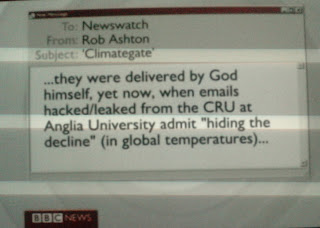
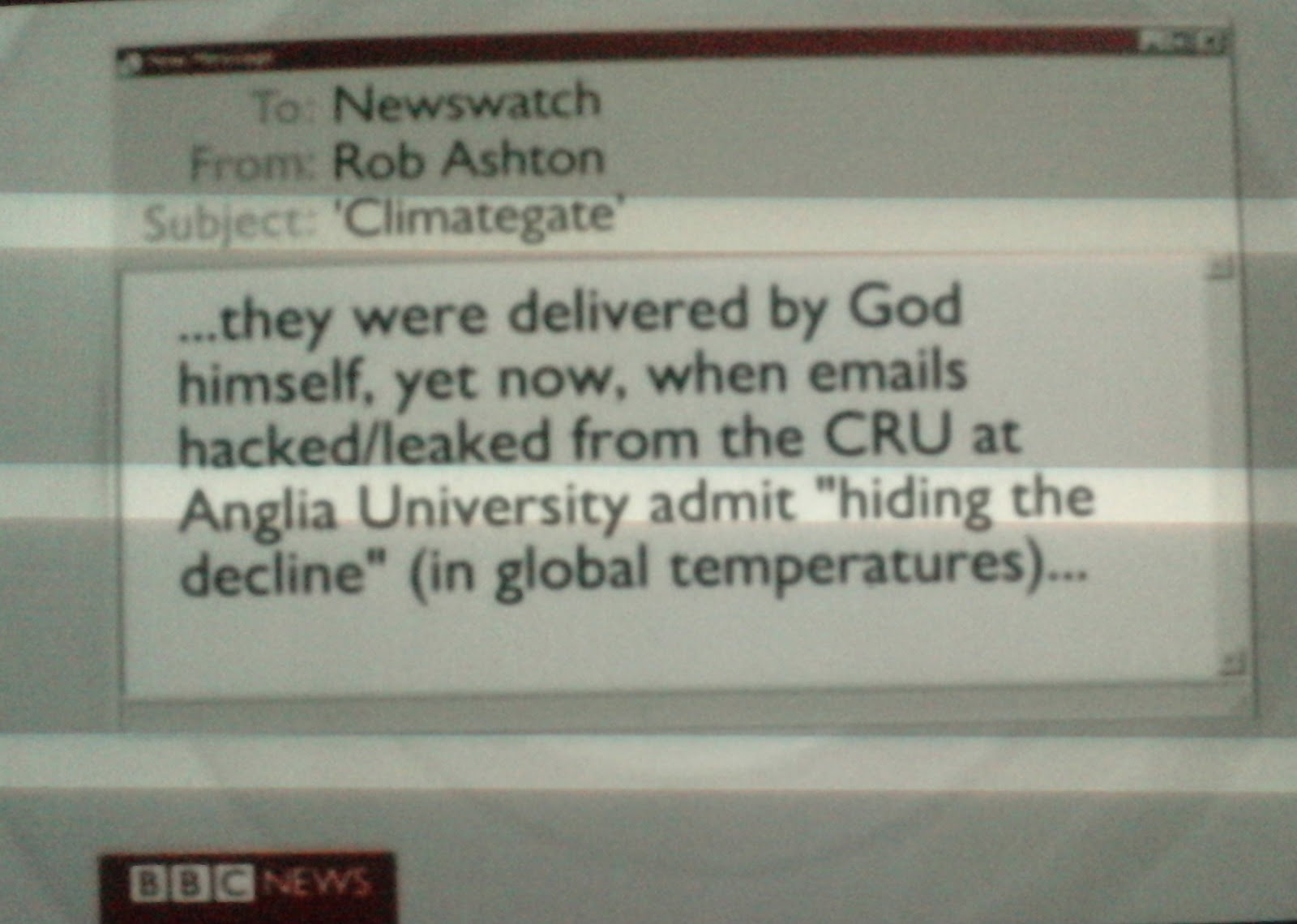
An email is shown on your programme saying '...the CRU at Anglia University admit "hiding the the decline" (in global temperatures)' . But that is not true. The CRU have never admitted any such thing and no hacked email says that either. The words in brackets were added by your correspondent clearly trying to make a partisan point. Are you going to make an effort to correct the record and apologise?
Salutations
Hengist McStone
I write about your December 4th 2009 broadcast . The rules on impartiality (which were referred to in the programme) say that skeptics should not get half the space, yet there were two skeptics in the studio and only one proponent. This programme was transmitted in the immediate aftermath of the release of hacked emails from the University of East Anglia. The skeptics only contemporaneous complaint is that there had not been enough conjecture on the BBC. They could not be complaining contemporaneously that the BBC was not reporting facts because very few facts were known at that time. Since then three public enquiries have exonerated the scientists, but you haven't reported that on Newswatch.
I have to put it to you that speculation against the victims of a crime is not a standard that I have ever seen elsewhere on the BBC's news coverage. Why was that standard adopted by yourselves in this case?
An email is shown on your programme saying '...the CRU at Anglia University admit "hiding the the decline" (in global temperatures)' . But that is not true. The CRU have never admitted any such thing and no hacked email says that either. The words in brackets were added by your correspondent clearly trying to make a partisan point. Are you going to make an effort to correct the record and apologise?
Salutations
Hengist McStone
Thursday, 18 November 2010
CRU hack: Skeptics wrote emails to suit BBC news programme!
Have found quite an extraordinary broadcast from last year which examines bias on the BBC's coverage of the climategate story less than two weeks into the affair. Essentially the programme suggests there may be a pro-green or pro-climate science bias. This is done by inviting two skeptic activists on to the programme to ask why hasn't the BBC given more skeptical coverage to the story. What is extraordinary is that this was broadcast on December 4th 2009 when few if any facts were known, as shown by this handy Guardian Timeline graphic.
The broadcast reports skeptical activists conspiracy theories at one point even adding words in to the emails to make a completely bogus point. An email is shown saying 'the CRU at Anglia University admit "hiding the the decline" (in global temperatures)' .
For the record the CRU do not admit any such thing and no hacked email says that either. This is an email sent to the BBC and the words in brackets have been added by a skeptic activist . Never let the truth get in the way of a good story! The University of East Anglia explained in late February in it's submission to Parliament exactly what the phrase "hide the decline" means, and it's not anything to do with global temperatures. So aren't the BBC jumping the gun here?
This is a propagandist's trick pretending to bend over backwards at being impartial (which we've seen before) . Rather than report facts, which could prove to be wrong, they are reporting concerns about their own bias , but concerns only from one side. Leaving the audience to conclude that the complainant has been wronged. It is a technique which leaves it's mark not just for what is said but for what is not said, because the clear implication is that there is something being held back. In the context of the timing it's difficult to see what the two skeptics could have complained about. Devoid of any contemporaneous gripe they instead recite the usual litany of (unchallenged) moans about the science and politics . At the time, the one thing that really needed to be established was the facts, instead the BBC gave us skeptic activists complaining not about facts but about their viewpoint .
Could it be that amongst the media frenzy of the first couple of weeks the broadcaster was unable to report any damning evidence from inchoate facts and in danger of falling behind it's competitors in the mainstream media. So a programme was done musing over whether the BBC itself was biased against the skeptics. As I can testify, the examination of bias is not an exact science, so if a broadcaster of the BBCs standing suggests it may itself be biased itself who's to argue?
One final point for now. Richard Black explains at some point about the BBCs impartiality document** which states that skeptics get less than half the 'space' . Yet there are only four people in the studio including the presenter (who is presumably unconvinced either way). Two of those are skeptics. There are no proponents of AGW apart from Black, and no one to defend the scientists at all. So that's 66% of the space going to the skeptics. Here we see the impartiality rules being explained to skeptics whilst ignoring the impartiality rules.
I find the deceipt going on by the commission of this programme to be deeply unsettling. I complain about BBC bias regularly. I have put in countless complaints this year, most of which have been completely ignored by the BBC. Yet here we see skeptic activists getting access to the airwaves only two weeks into the scandal to complain about nothing more than a percieved lack of speculation by the BBC, at a time when the only known fact was that the CRU had been hacked, which was of course a crime against the scientists.
** From SeeSaw to Wagon Wheel page 40
P.S. After many months three enquiries into the hacked emails cleared the scientists. The corresponding Newswatch programmes were broadcast on 9th April, 16th April and finally 10th July. But these programmes do not find time to mention the exoneration of the scientists.
Am working through the rest of the broadcasts. 23rd April is interesting, it's on science in general and contains an interview with Phallab Ghosh and one with the enigmatic Fiona Fox (director of the Science Media Centre and LM Group so she has a foot in both camps). Doesn't mention that the first enquiry was already in by then though.
The broadcast reports skeptical activists conspiracy theories at one point even adding words in to the emails to make a completely bogus point. An email is shown saying 'the CRU at Anglia University admit "hiding the the decline" (in global temperatures)' .
For the record the CRU do not admit any such thing and no hacked email says that either. This is an email sent to the BBC and the words in brackets have been added by a skeptic activist . Never let the truth get in the way of a good story! The University of East Anglia explained in late February in it's submission to Parliament exactly what the phrase "hide the decline" means, and it's not anything to do with global temperatures. So aren't the BBC jumping the gun here?
This is a propagandist's trick pretending to bend over backwards at being impartial (which we've seen before) . Rather than report facts, which could prove to be wrong, they are reporting concerns about their own bias , but concerns only from one side. Leaving the audience to conclude that the complainant has been wronged. It is a technique which leaves it's mark not just for what is said but for what is not said, because the clear implication is that there is something being held back. In the context of the timing it's difficult to see what the two skeptics could have complained about. Devoid of any contemporaneous gripe they instead recite the usual litany of (unchallenged) moans about the science and politics . At the time, the one thing that really needed to be established was the facts, instead the BBC gave us skeptic activists complaining not about facts but about their viewpoint .
Could it be that amongst the media frenzy of the first couple of weeks the broadcaster was unable to report any damning evidence from inchoate facts and in danger of falling behind it's competitors in the mainstream media. So a programme was done musing over whether the BBC itself was biased against the skeptics. As I can testify, the examination of bias is not an exact science, so if a broadcaster of the BBCs standing suggests it may itself be biased itself who's to argue?
One final point for now. Richard Black explains at some point about the BBCs impartiality document** which states that skeptics get less than half the 'space' . Yet there are only four people in the studio including the presenter (who is presumably unconvinced either way). Two of those are skeptics. There are no proponents of AGW apart from Black, and no one to defend the scientists at all. So that's 66% of the space going to the skeptics. Here we see the impartiality rules being explained to skeptics whilst ignoring the impartiality rules.
I find the deceipt going on by the commission of this programme to be deeply unsettling. I complain about BBC bias regularly. I have put in countless complaints this year, most of which have been completely ignored by the BBC. Yet here we see skeptic activists getting access to the airwaves only two weeks into the scandal to complain about nothing more than a percieved lack of speculation by the BBC, at a time when the only known fact was that the CRU had been hacked, which was of course a crime against the scientists.
** From SeeSaw to Wagon Wheel page 40
P.S. After many months three enquiries into the hacked emails cleared the scientists. The corresponding Newswatch programmes were broadcast on 9th April, 16th April and finally 10th July. But these programmes do not find time to mention the exoneration of the scientists.
Am working through the rest of the broadcasts. 23rd April is interesting, it's on science in general and contains an interview with Phallab Ghosh and one with the enigmatic Fiona Fox (director of the Science Media Centre and LM Group so she has a foot in both camps). Doesn't mention that the first enquiry was already in by then though.
Subscribe to:
Comments (Atom)