Have found quite an extraordinary broadcast from last year which examines bias on the BBC's coverage of the climategate story less than two weeks into the affair. Essentially the programme suggests there may be a pro-green or pro-climate science bias. This is done by inviting two skeptic activists on to the programme to ask why hasn't the BBC given more skeptical coverage to the story. What is extraordinary is that this was broadcast on December 4th 2009 when few if any facts were known, as shown by this handy Guardian Timeline graphic.
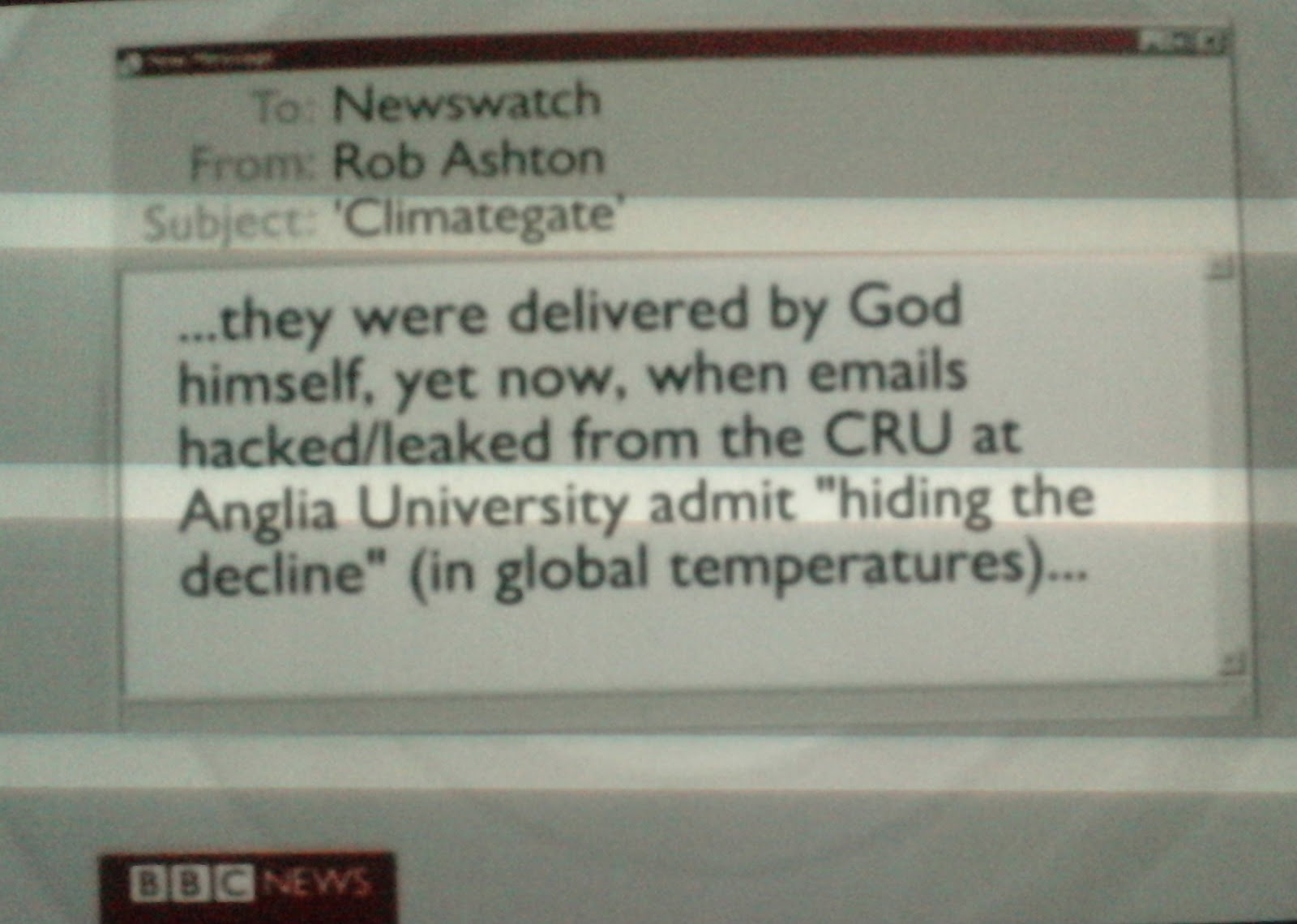
The broadcast reports skeptical activists conspiracy theories at one point even adding words in to the emails to make a completely bogus point. An email is shown saying 'the CRU at Anglia University admit "hiding the the decline" (in global temperatures)' .
For the record the CRU do not admit any such thing and no hacked email says that either. This is an email sent to the BBC and the words in brackets have been added by a skeptic activist . Never let the truth get in the way of a good story! The University of East Anglia explained in late February in it's submission to Parliament exactly what the phrase "hide the decline" means, and it's not anything to do with global temperatures. So aren't the BBC jumping the gun here?
This is a propagandist's trick pretending to bend over backwards at being impartial (which we've seen before) . Rather than report facts, which could prove to be wrong, they are reporting concerns about their own bias , but concerns only from one side. Leaving the audience to conclude that the complainant has been wronged. It is a technique which leaves it's mark not just for what is said but for what is not said, because the clear implication is that there is something being held back. In the context of the timing it's difficult to see what the two skeptics could have complained about. Devoid of any contemporaneous gripe they instead recite the usual litany of (unchallenged) moans about the science and politics . At the time, the one thing that really needed to be established was the facts, instead the BBC gave us skeptic activists complaining not about facts but about their viewpoint .
Could it be that amongst the media frenzy of the first couple of weeks the broadcaster was unable to report any damning evidence from inchoate facts and in danger of falling behind it's competitors in the mainstream media. So a programme was done musing over whether the BBC itself was biased against the skeptics. As I can testify, the examination of bias is not an exact science, so if a broadcaster of the BBCs standing suggests it may itself be biased itself who's to argue?
One final point for now. Richard Black explains at some point about the BBCs impartiality document** which states that skeptics get less than half the 'space' . Yet there are only four people in the studio including the presenter (who is presumably unconvinced either way). Two of those are skeptics. There are no proponents of AGW apart from Black, and no one to defend the scientists at all. So that's 66% of the space going to the skeptics. Here we see the impartiality rules being explained to skeptics whilst ignoring the impartiality rules.
I find the deceipt going on by the commission of this programme to be deeply unsettling. I complain about BBC bias regularly. I have put in countless complaints this year, most of which have been completely ignored by the BBC. Yet here we see skeptic activists getting access to the airwaves only two weeks into the scandal to complain about nothing more than a percieved lack of speculation by the BBC, at a time when the only known fact was that the CRU had been hacked, which was of course a crime against the scientists.
** From SeeSaw to Wagon Wheel page 40
P.S. After many months three enquiries into the hacked emails cleared the scientists. The corresponding Newswatch programmes were broadcast on 9th April, 16th April and finally 10th July. But these programmes do not find time to mention the exoneration of the scientists.
Am working through the rest of the broadcasts. 23rd April is interesting, it's on science in general and contains an interview with Phallab Ghosh and one with the enigmatic Fiona Fox (director of the Science Media Centre and LM Group so she has a foot in both camps). Doesn't mention that the first enquiry was already in by then though.
Does the BBC's discordant climate output mask a conspiracy of ignorance? asks Hengist McStone.
Thursday, 18 November 2010
Friday, 22 October 2010
BBC head honcho interviewed on Radio 4
The BBC announces new editorial guidelines that concern climate change. Science has been added to the list of controversial subjects, I gather . I haven't yet found the BBC's official announcement but the skeptics seem to think this will benefit them. David Jordan, Controller Editorial Policy is the author of the new guidelines and was interviewed by the esteemed Roger Bolton on Feedback, for the record here's what was said.
RB: Can I start by asking you... it is the attitude that producers should take to the question of climate change. Is it alright for a programme maker to proceed on the basis that climate change is occurring and it is largely man made?
DJ: The way we approach scientific controversy and indeed other controversies where there is a general consensus about something being the case is to say that we don't have to in every time we mention the issue have a balance of view one way or the other, in fact you can distort the debate if every time you talk about man made climate change you have somebody who either denies that it's happening at all or doesn't believe that it's man made. The important thing is that in our airwaves and in our coverage it's acknowledged that there are people who don't accept that there is man made climate change. They don't have to be part of every programme we make on the subject or be part of every discussion we do on the subject provided across our airwaves in general that view is reflected from time to time.
RB: You say they don't have to refer to the alternative view but do they have to critically question those who are saying that it is a proven reality?
DJ: It's appropriate for any report on those subjects to cross examine or question any assumptions that people may be making but it isn't necessary for the two different views always to be represented equally in any given programme.
RB: But no BBC programme should be a campaigning programme on an issue like this.
DJ: No. We don't do campaigning. We report
RB (interrupts) We shouldn't do but some of our listeners would think some programmes are campaigning.
DJ: We report campaigns and we shouldn't ever be campaigning on issues of this sort. Other than issues around broadcasting the BBC doesn't take sides and doesn't have a view.
RB; Can we move on to the new guidelines that you've just published. why are they needed, what has happened to make them necessary in your view?
DJ: Well, you know Roger, someone as long in the tooth as you are, knows that things change over the years we've had a lot of
RB: (interrupts) Principals don't change do they?
DJ: No the principals may not change hugely but the last one was produced in the wake of the Hutton Inquiry and the Gilligan affair, this one's being produced in the wake of some major editorial policy shocks, namely the telephony and interactivity issues, the issues over queengate and latterly the Brand Ross issue.
RB: Now you're extending the ideas of impartiality to a wider area. Theres an investigation by the Trust about the question of science and there's the issue of religion where you have at least in the view of the National Secular Society given further protection from offence to religious believers , have you done that?
(Interview continues on the subject of religion)
RB: Can I start by asking you... it is the attitude that producers should take to the question of climate change. Is it alright for a programme maker to proceed on the basis that climate change is occurring and it is largely man made?
DJ: The way we approach scientific controversy and indeed other controversies where there is a general consensus about something being the case is to say that we don't have to in every time we mention the issue have a balance of view one way or the other, in fact you can distort the debate if every time you talk about man made climate change you have somebody who either denies that it's happening at all or doesn't believe that it's man made. The important thing is that in our airwaves and in our coverage it's acknowledged that there are people who don't accept that there is man made climate change. They don't have to be part of every programme we make on the subject or be part of every discussion we do on the subject provided across our airwaves in general that view is reflected from time to time.
RB: You say they don't have to refer to the alternative view but do they have to critically question those who are saying that it is a proven reality?
DJ: It's appropriate for any report on those subjects to cross examine or question any assumptions that people may be making but it isn't necessary for the two different views always to be represented equally in any given programme.
RB: But no BBC programme should be a campaigning programme on an issue like this.
DJ: No. We don't do campaigning. We report
RB (interrupts) We shouldn't do but some of our listeners would think some programmes are campaigning.
DJ: We report campaigns and we shouldn't ever be campaigning on issues of this sort. Other than issues around broadcasting the BBC doesn't take sides and doesn't have a view.
RB; Can we move on to the new guidelines that you've just published. why are they needed, what has happened to make them necessary in your view?
DJ: Well, you know Roger, someone as long in the tooth as you are, knows that things change over the years we've had a lot of
RB: (interrupts) Principals don't change do they?
DJ: No the principals may not change hugely but the last one was produced in the wake of the Hutton Inquiry and the Gilligan affair, this one's being produced in the wake of some major editorial policy shocks, namely the telephony and interactivity issues, the issues over queengate and latterly the Brand Ross issue.
RB: Now you're extending the ideas of impartiality to a wider area. Theres an investigation by the Trust about the question of science and there's the issue of religion where you have at least in the view of the National Secular Society given further protection from offence to religious believers , have you done that?
(Interview continues on the subject of religion)
Wednesday, 13 October 2010
World Service only half biased
With comparative lightning speed the World Service's One Planet have responded to the point I made last week. It seems we have to follow the whole series to see impartiality. I was expecting an answer like that. This episode shows up how awkward it is to monitor the question of impartiality. Perhap's the Editor's response could be paraphrased as "this was only half biased." More thoughts to follow. Here's what he has to say:
Many thanks for your email, I always appreciate it when people take the time to write into the One Planet team.
I was aware that the interview with Professor Lindzen would open up the show to criticism from many people. But I do think it was right to speak with him. It's not often that we interview a climate change denier on the show (reflecting the fact that it remains a minority view among scientists), but it would be wrong of us to simply ignore the issue or pretend it doesn't exist. That does no one any favours as it fuels talk of conspiracies and cover ups. I believe it's much better to reveal the arguments being made on both sides, and allow listeners to make their
own choice. As you clearly have done.
I don't think anyone could accuse One Planet of giving equal time to those who do not believe in man-made climate change. And during the interview, Mike made a number of references to the fact that Professor Lindzen's view is in the minority. If - over the course of the One Planet series - you balance this show against the many other programmes which involve interviews with scientists, academics and politicians who strongly believe in the dangers posed by climate change, I believe One Planet offers a fair and impartial examination of the subject.
All the very best,
Steven
Steven Duke
Editor, One Planet
Many thanks for your email, I always appreciate it when people take the time to write into the One Planet team.
I was aware that the interview with Professor Lindzen would open up the show to criticism from many people. But I do think it was right to speak with him. It's not often that we interview a climate change denier on the show (reflecting the fact that it remains a minority view among scientists), but it would be wrong of us to simply ignore the issue or pretend it doesn't exist. That does no one any favours as it fuels talk of conspiracies and cover ups. I believe it's much better to reveal the arguments being made on both sides, and allow listeners to make their
own choice. As you clearly have done.
I don't think anyone could accuse One Planet of giving equal time to those who do not believe in man-made climate change. And during the interview, Mike made a number of references to the fact that Professor Lindzen's view is in the minority. If - over the course of the One Planet series - you balance this show against the many other programmes which involve interviews with scientists, academics and politicians who strongly believe in the dangers posed by climate change, I believe One Planet offers a fair and impartial examination of the subject.
All the very best,
Steven
Steven Duke
Editor, One Planet
Friday, 8 October 2010
Response to BBC World Service 'One Planet' broadcast 3rd October featuring Dr Richard Lindzen
Most of this programme is given over to an interview with Dr Richard Lindzen who is clearly an opponent of the scientific consensus. The BBC's guide on impartiality in this field states :”the weight of evidence no longer justifies equal space being given to the opponents of the consensus. But these dissenters (or even sceptics) will still be heard, as they should, because it is not the BBC’s role to close down this debate. ” (From Seesaw to Wagon Wheel page 40)
There was nobody to rebut his assertions . It was not a debate . Dr. Lindzen's views were broadcast largely without criticism. In this programme the sceptics are clearly getting more than equal space. I suggest this is against the rules established for the BBC's impartiality.
Most of this programme is given over to an interview with Dr Richard Lindzen who is clearly an opponent of the scientific consensus. The BBC's guide on impartiality in this field states :”the weight of evidence no longer justifies equal space being given to the opponents of the consensus. But these dissenters (or even sceptics) will still be heard, as they should, because it is not the BBC’s role to close down this debate. ” (From Seesaw to Wagon Wheel page 40)
There was nobody to rebut his assertions . It was not a debate . Dr. Lindzen's views were broadcast largely without criticism. In this programme the sceptics are clearly getting more than equal space. I suggest this is against the rules established for the BBC's impartiality.
Thursday, 30 September 2010
BBC misrepresented scientists behind empirical paper - Fact.
Have sent a follow up to my unanswered complaint about BBC Online's report of the Anderegg paper.
Hello, I sent a complaint about this article on August 9th and I have not received a reply. Paragraph 12 says that the motivations of the researchers was in part a response to 'recent scandals, such as "climategate" at the UK's University of East Anglia and the use of non-peer reviewed literature in the IPCC findings.' The press release from Stanford University does not cite these events, and I have to put it to you on that evidence alone the author of your report is speculating rather than quoting facts. But I have since been in touch with one of the authors of the scientific paper Mr Jim Prall of Toronto University * who states that Dr Anderegg contacted him in August 2009 and they began working on their paper the following month. It was not until November 2009 that the UEA emails were released . Ergo your reporter's speculations about the motivations behind this study amount to a factual error.
Needless to say, I also stand by my earlier remarks about your reporters sceptical commentary .
Or to put it more simply the BBC reporter made up the bits about motivations behind the paper, this can be proved by looking at the dates Anderegg and Prall had begun work on the paper.
So why am I so hot under the collar about this pissy little article? Well, it's about a very important scientific paper that could not be ignored, which gives empirical evidence for public understanding of climate science . The reporter is keen to present it as a 'he said she said' argument, when it is nothing of the sort. The report introduces what sceptics have to say in the third paragraph and concludes with the sceptics too. But the BBC report also suggests that the media bias is only as recent as , and limited to, the recent peccadilloes highlighted . The press release from Stanford University clearly suggests the paper is motivated by much wider and deeper frustrations.
"It is sad that we even have to do this," said the late Doctor Stephen Schneider. "[Too much of] the media world has just folded up and fired its reporters with expertise in science."
* Correpondence available in comments at http://birdbrainscan.blogspot.com/2009/07/great-climate-skeptics-swindle.html
UPDATE: Phoned BBC 15th November to chase it up, was given a reference number, was told I would get a reply in ten days.
UPDATE: Phoned BBC 6th December to chase it up, was given a reference number, was told I would get a reply in ten days.
P.S. And for those that want to see how a science article should be written, Martin Robbins of The Guardian helpfully provides a pro-forma.
Hello, I sent a complaint about this article on August 9th and I have not received a reply. Paragraph 12 says that the motivations of the researchers was in part a response to 'recent scandals, such as "climategate" at the UK's University of East Anglia and the use of non-peer reviewed literature in the IPCC findings.' The press release from Stanford University does not cite these events, and I have to put it to you on that evidence alone the author of your report is speculating rather than quoting facts. But I have since been in touch with one of the authors of the scientific paper Mr Jim Prall of Toronto University * who states that Dr Anderegg contacted him in August 2009 and they began working on their paper the following month. It was not until November 2009 that the UEA emails were released . Ergo your reporter's speculations about the motivations behind this study amount to a factual error.
Needless to say, I also stand by my earlier remarks about your reporters sceptical commentary .
Or to put it more simply the BBC reporter made up the bits about motivations behind the paper, this can be proved by looking at the dates Anderegg and Prall had begun work on the paper.
So why am I so hot under the collar about this pissy little article? Well, it's about a very important scientific paper that could not be ignored, which gives empirical evidence for public understanding of climate science . The reporter is keen to present it as a 'he said she said' argument, when it is nothing of the sort. The report introduces what sceptics have to say in the third paragraph and concludes with the sceptics too. But the BBC report also suggests that the media bias is only as recent as , and limited to, the recent peccadilloes highlighted . The press release from Stanford University clearly suggests the paper is motivated by much wider and deeper frustrations.
"It is sad that we even have to do this," said the late Doctor Stephen Schneider. "[Too much of] the media world has just folded up and fired its reporters with expertise in science."
* Correpondence available in comments at http://birdbrainscan.blogspot.com/2009/07/great-climate-skeptics-swindle.html
UPDATE: Phoned BBC 15th November to chase it up, was given a reference number, was told I would get a reply in ten days.
UPDATE: Phoned BBC 6th December to chase it up, was given a reference number, was told I would get a reply in ten days.
P.S. And for those that want to see how a science article should be written, Martin Robbins of The Guardian helpfully provides a pro-forma.
Sunday, 5 September 2010
Manufacturing Ignorance
In "Manufacturing Consent" Noam Chomsky laments that the attention span of television news reporting is so short that only conventional thoughts can be expressed. Chomsky's brand of dissent is undermined by insufficient airtime, in the parlance of TV journalism it is called 'concision'. Global warming advocates are particularly susceptible to concision because of all the uncertainties and unravelling decades of misinformation . In short the unfolding narrative goes that the scientists present a dire prediction then the skeptical mass media ask how bleak? When the scientists express uncertainty the media move on. The effect is one of uncertain scientists rather than the bleak outlook.
This trick was skilfully played when Kirsty Wark on Newsnight (23rd August 2010) asked are the floods in Pakistan due to climate change? It's not a yes or no question, that unfortunately was posed as a yes or no question. Before we look at Newsnight's effort let's consider some informed opinion , here's Dr Kevin Trenberth on the subject:
Then there's Dr James Hansen who fairly observes essentially changing the climate is like loading a dice. A more unstable climate is more likely to give us extreme weather events and hence there will be more extreme weather events. But nailing a specific extreme weather event and asking if it is down to climate change is a different ball game*, and whilst the science, and effects of climate change are so hotly disputed one has to ask what purpose does Kirsty Wark's question serve?
Imagine you are in a casino and your suspicions lead you to say out loud that the roulette wheel might be loaded . And the croupier's response is to claim that the last spin might not have been different if the wheel weren't loaded; the sensible gambler should not find such a remark comforting and conclude it was time to give up.
Perhaps, when BBC producers commissioned this particular debate, they expected all critics to give up. So here's my two cents worth.
BBC news programmes habitually present climate related matters as two sided , a duel between skeptics and everyone else. For expert opinion the BBC chose Dr. Ghassem Asrar, a man with academic credentials in climate science as long as your arm who was cited as from the World Climate Research Project but is also from NASA. a doctor with membership of five professional societies and numerous awards was not enough for the BBC so they called on Andrew Montford a chartered accountant from Kinross. An odd choice for the question at hand because Montford's credentials are that he cannot agree on what the climate has been over the last millenium. Montford largely agreed with the eminent doctor, so was he on the programme for balance or for concision?
A chilling theme of the debate was that now that climate change is upon us, mitigation is obsolete and the question becomes how to adapt.Wark suggested proacive work be done in the form of local levees. But carbon was not mentioned once. The word mitigate was used only once, by Montford, erroneously or mendaciously suggesting that local adaptive measures were mitigation.
The consensus inevitably reached was that you can't say that these particular floods in Pakistan are due to climate change. But that is due to the 'crooked croupier's proposition' given above. Never did they mention the caveat that the extreme weather events we are beginning to witness now are just the kind of thing scientists would expect in a global warming world .
For no good reason at the end of the debate Wark asked after climategate are scientists becoming more cautious in pronouncing on what could be aspects of global warming? Montford was asked "do you accept climate change is a grave risk facing us all," to which he blustered "errm from my perspective I think the answer is I don't know. I think mankind is affecting the climate but whether it's a little or a lot , I think , in reality we really just don't know"
'We really just don't know' is the so called informed opinion they would like to leave you with on climate change. You've got to hand it to those folks at the BBC - they are skilled propagandists. Wark deserves particular opprobrium for fronting this angle, which seems trivial with two million homeless and thousands dead . Of course it's anything but trivial , such is the twisted nature of the media's reporting of our changing climate.
* A sensible discussion of the question is offered by Michael Tobis in 'When it Rains it Pours'
This trick was skilfully played when Kirsty Wark on Newsnight (23rd August 2010) asked are the floods in Pakistan due to climate change? It's not a yes or no question, that unfortunately was posed as a yes or no question. Before we look at Newsnight's effort let's consider some informed opinion , here's Dr Kevin Trenberth on the subject:
“I find it systematically tends to get underplayed and it often gets underplayed by my fellow scientists. Because one of the opening statements, which I’m sure you’ve probably heard is “Well you can’t attribute a single event to climate change.” But there is a systematic influence on all of these weather events now-a-days because of the fact that there is this extra water vapor lurking around in the atmosphere than there used to be say 30 years ago. It’s about a 4% extra amount, it invigorates the storms, it provides plenty of moisture for these storms and it’s unfortunate that the public is not associating these with the fact that this is one manifestation of climate change. And the prospects are that these kinds of things will only get bigger and worse in the future.”
Then there's Dr James Hansen who fairly observes essentially changing the climate is like loading a dice. A more unstable climate is more likely to give us extreme weather events and hence there will be more extreme weather events. But nailing a specific extreme weather event and asking if it is down to climate change is a different ball game*, and whilst the science, and effects of climate change are so hotly disputed one has to ask what purpose does Kirsty Wark's question serve?
Imagine you are in a casino and your suspicions lead you to say out loud that the roulette wheel might be loaded . And the croupier's response is to claim that the last spin might not have been different if the wheel weren't loaded; the sensible gambler should not find such a remark comforting and conclude it was time to give up.
Perhaps, when BBC producers commissioned this particular debate, they expected all critics to give up. So here's my two cents worth.
BBC news programmes habitually present climate related matters as two sided , a duel between skeptics and everyone else. For expert opinion the BBC chose Dr. Ghassem Asrar, a man with academic credentials in climate science as long as your arm who was cited as from the World Climate Research Project but is also from NASA. a doctor with membership of five professional societies and numerous awards was not enough for the BBC so they called on Andrew Montford a chartered accountant from Kinross. An odd choice for the question at hand because Montford's credentials are that he cannot agree on what the climate has been over the last millenium. Montford largely agreed with the eminent doctor, so was he on the programme for balance or for concision?
A chilling theme of the debate was that now that climate change is upon us, mitigation is obsolete and the question becomes how to adapt.Wark suggested proacive work be done in the form of local levees. But carbon was not mentioned once. The word mitigate was used only once, by Montford, erroneously or mendaciously suggesting that local adaptive measures were mitigation.
The consensus inevitably reached was that you can't say that these particular floods in Pakistan are due to climate change. But that is due to the 'crooked croupier's proposition' given above. Never did they mention the caveat that the extreme weather events we are beginning to witness now are just the kind of thing scientists would expect in a global warming world .
For no good reason at the end of the debate Wark asked after climategate are scientists becoming more cautious in pronouncing on what could be aspects of global warming? Montford was asked "do you accept climate change is a grave risk facing us all," to which he blustered "errm from my perspective I think the answer is I don't know. I think mankind is affecting the climate but whether it's a little or a lot , I think , in reality we really just don't know"
'We really just don't know' is the so called informed opinion they would like to leave you with on climate change. You've got to hand it to those folks at the BBC - they are skilled propagandists. Wark deserves particular opprobrium for fronting this angle, which seems trivial with two million homeless and thousands dead . Of course it's anything but trivial , such is the twisted nature of the media's reporting of our changing climate.
* A sensible discussion of the question is offered by Michael Tobis in 'When it Rains it Pours'
Monday, 9 August 2010
Falsehoods and bias in BBC Science report
On 24th June BBC online published "Study examines scientists 'climate credibility'" , in response to a carefully thought out empirical paper on scientific expertise in climate science. It was an important paper as the press release from Stanford University shows. Read the press release then read the BBC's article and see if you think the BBC's article is fair. Here is my complaint, sent August 9th 2010:
I have compared the Stanford Press Release to your article and have to say that the claim you make in paragraph 12 is false if it is based on that press release.
Please could you cite your source for the claim that the Anderegg study was a response to the specific recent scandals you refer to.
This article breaks the story of one of the most important scientific papers published recently for public understanding of Climate Change. You say “Sceptical groups, however, argued that publication in scientific journals was not a fair test of expertise.” That is not a view being honestly held or coherently expressed because no alternative measure is offered.
Your suggestion that Dr Sonja Boehmer-Christiansen is an impartial observer is false. She is a founder of a pressure group called the “Scientific Alliance” which recieves funds from the mining industry, Whilst Dr Sonja Boehmer-Christiansen is from the University of Hull, she is an Emeritus Reader in geography, therefore retired. Her criticisms of Anderegg et al would have to apply to herself if you were being even handed.
Concluding your article with her quote “that the authors belong to an IPCC supporting group that must count as believers and belong to the beneficiaries of the man-made warming scare” is biased . Such a statement deserves to be investigated if true. It can be investigated as I demonstrate in the above paragraph , and I have found that this article is manufacturing a controversy to suit industry and special interest groups.
I have compared the Stanford Press Release to your article and have to say that the claim you make in paragraph 12 is false if it is based on that press release.
Please could you cite your source for the claim that the Anderegg study was a response to the specific recent scandals you refer to.
This article breaks the story of one of the most important scientific papers published recently for public understanding of Climate Change. You say “Sceptical groups, however, argued that publication in scientific journals was not a fair test of expertise.” That is not a view being honestly held or coherently expressed because no alternative measure is offered.
Your suggestion that Dr Sonja Boehmer-Christiansen is an impartial observer is false. She is a founder of a pressure group called the “Scientific Alliance” which recieves funds from the mining industry, Whilst Dr Sonja Boehmer-Christiansen is from the University of Hull, she is an Emeritus Reader in geography, therefore retired. Her criticisms of Anderegg et al would have to apply to herself if you were being even handed.
Concluding your article with her quote “that the authors belong to an IPCC supporting group that must count as believers and belong to the beneficiaries of the man-made warming scare” is biased . Such a statement deserves to be investigated if true. It can be investigated as I demonstrate in the above paragraph , and I have found that this article is manufacturing a controversy to suit industry and special interest groups.
Subscribe to:
Comments (Atom)