Dear Sir,
I was disappointed to read the reply to my earlier letter to the BBC Trust which was dealt with by BBC Complaints . It apologises many times for the way the complaint has been handled but at no time has the BBC apologised or admitted fault for the broadcast itself. This is odd because there remain important issues which BBC Complaints have steadfastly refused to address.
I am considering resolved all the issues which have been addressed by this correspondence regardless of whether I feel they were answered satisfactorily. This is to assist the BBC Trust in focussing on the matters outstanding. It should be noted that the matters remaining have all been raised more than once in the course of this correspondence. Firstly I have a question, who were the nearly 200 “hard core deep environmentalists” referred to by Solitaire Townsend ? If that question cannot or will not be answered then an explanation is necessary for why the BBC is broadcasting unsubstantiated accusations about people it cannot identify. Resolving that question is also necessary to address my other outstanding concerns. Namely that the broadcast fell outside sections 7.9 and 7.13 of the OFCOM Broadcasting Code.
I put it to you that it was incumbent on the programme makers to make some effort to identify the 200 environmentalists (either collectively or as individuals) because Sections 7.9 states "anyone whose omission could be unfair to an individual or organisation has been offered an opportunity to contribute". Unless the programme makers identified the 200 or so environmentalists the programme makers could not have offered them an opportunity to contribute. The BBC has thus far refused to address this question.
Ms Townsend’s claim that she knows the motivations of the environmentalists in question is nothing more than opinion, dressed up as fact, there would be another side which the broadcast did not consider ie the real motivations of the environmentalists. To that extent the broadcast was unfair. Ms Townsend makes the statement “I was angry because it really showed that they wanted more. They didn’t just want to prevent climate change. They wanted to somehow change people, or at very least for people to know that they had to change.” It is derived from an exchange between herself and the presenter (from 1:50 to 3:09)it is too contrived to be considered a casual opinion that sneaked through the editing process. From that viewpoint I invite you to consider that this is more than sloppy journalism it is misleading, Ms Townsend’s words are conjecture but they are presented unchallenged as if they were much more.
Section 7.9 states “broadcasters should take reasonable care to satisfy themselves that: material facts have not been presented, disregarded or omitted in a way that is unfair to an individual or organization” since Ms Townsend’s contribution made the motivations of the 200 environmentalists material it is incumbent to point out that the actual views or real motivations of the 200 or so environmentalists have been omitted. Ms Townsend has not been elected to speak for them but that is what is effectively going on in your programme. Furthermore Ms Townsend’s opinion of the motivations of the people she claims to have met (but has refused to identify) was extrapolated to imply is indicative of the environmental movement as a whole. A completely unscientific and immoral way of tarring a wide group of people with the same brush.
Finally I ought to record that it is lamentable that the BBC complaints process has not ascertained sufficient facts to deal with this matter properly before now and also that the BBC complaints process has ignored a complaint that a broadcast is outside OFCOM’s rules. As you know OFCOM is a form of external governance to the BBC and it looks very poor that the BBC has not answered concerns within the ambit of OFCOM before now.
Yours Sincerely
Hengist McStone
Tuesday, 1 November 2011
Monday, 17 October 2011
BBC: "to add to the confusion..."
Today I have recieved a long letter from the BBC which claims to answer my most recent letter to them and my recent letter to the BBC Trust, thereby blurring the distinction between the BBC and the BBC Trust. It goes over the ground of who wrote to whom when. I am absolutely baffled by paragraph four .
"The confusion was spotted and a letter was written to you much later in the process tying all your complaints together. To add to the confusion you did not recieve this letter (I am unable to discover why it was not delivered) and so another was sent on 6 January 2011. It apologised extensively and cleared up the misunderstandings, then went on to address the original points you made in your various complaints but within one single letter."
Needless to say I never got a letter from the BBC around 6th January 2011.
Keith Jones Head of Communications and Complaints concludes with the words "I have responded to your points about handling in full in this letter and feel I can add no more at this stage" and that there are 20 working days to appeal to the BBC Trust.
Will do.
Monday, 26 September 2011
Letter to the BBC Trust
23rd September 2011
BBC Trust Unit
180 Great Portland Street
London
W1W 5QZ
Dear Sirs,
"Are Environmentalists Bad for the Planet" BBC Radio 4
Last year I raised a number of specific concerns about the above programme to the BBC Complaints Unit which to all intents and purposes have been lost rather than dealt with.
I understand that the BBC is subject to the OFCOM Broadcasting Code and I cited sections 7.9 and 7.13 of the OFCOM Broadcasting Code as having been breached (I first did that through the BBC's internet complaints portal on 21st February 2010 ) . Despite the fact that I have raised the matter of sections 7.9 and 7.13 many times since the BBC have never addressed it. This correspondence indicates that the BBC Complaints process is able to filibuster a complaint under the OFCOM Broadcasting Code despite the fact that OFCOM is external to the BBC.
I recieved a letter from Gemma McAleer earlier this month telling me the matter was out of time, but it is the BBC that have been tardy in dealing with this, I should also add that her chronology was flawed. I also have a specific question that I have raised numerous times which has been ignored and needs to be answered, in that light I contend that the one-sided account of a meeting by a contributor was untruthful and BBC programme makers have failed in their duty to see that the programme was truthful.
Stage two of the complaints process was dealth with by Sean Moss who took seven and a half months to respond, when he did so he gave no instructions on how to escalate this matter to yourselves.
I have spoken to OFCOM on the phone and they say to write to yourselves, which I am now doing. But I hasten to point out that unless you are able to engage in this correspondence the record would show that the BBC Complaints process can ignore accusations of stepping outside OFCOM's rules.
Salutations,
Hengist McStone
Thursday, 15 September 2011
... in the strongest possible terms...
Dear Sir,
I write in response to your letter from Gemma McAleer dated 7th September 2011.
It is your department that has lost track of this matter, therefore I have to put it to you in the strongest possible terms it is entirely inappropriate to dismiss this complaint as falling outside of your complaints timescale.
I did not recieve any communication from the BBC in November 2010 as you claim. The facts of the matter with regards to timescale are briefly as follows:
Programme broadcast 25th January 2010
First written complaint sent 5th Feb 2010
16th June 2010 undated letter recieved from Stefan Curran
My Stage 2 letter sent by rec'd delivery 9th August 2010
Follow up email requesting reply sent through your complaints portal 18th March 2011
Sean Moss replies by email 23rd March 2011
Sean Moss did not offer any method of escalating this matter to the BBC Trust. I understand that you are subject to the OFCOM Broadcasting Code and I have cited sections 7.9 and 7.13 of the OFCOM Broadcasting Code as having been breached (I first did that through your internet complaints portal on 21st February 2010 ) . Despite the fact that I have raised the matter of sections 7.9 and 7.13 many times since you have never addressed it.
The OFCOM Broadcasting Code is external to the BBC, I telephoned OFCOM earlier this week and they have advised that they can no longer consider this, however they advised me to write a letter to the BBC Trust.
I must say I no longer have any faith in the BBC complaints department to consider this matter. I have your answers and the gist is that the BBC ignores accusations that it has breached the OFCOM Broadcasting Code .
Now I am not entirely sure that any of us would like to leave this correspondence at that point. I will write to the BBC Trust in the next week asking for this matter to be heard by them. In the meantime I would be grateful if you would review whether it is correct to dismiss this complaint as out of time when it is mostly yourselves that have been tardy.
Salutations,
Hengist McStone
Friday, 9 September 2011
BBC goes all pythonesque
A letter arrives from the BBC apologizing for the time taken to process my complaint and saying that the time period to make a complaint has now elapsed .
Dear Mr McStone
Thanks for contacting us.
Please accept our apologies for the delay in our reply however, my colleague Sean Moss's reply to which you refer was sent in November 2010 and your e-mail was sent in May 2011
This falls outside of our complaints timescale which is published here :
http://www.bbc.co.uk/complaints/handle.shtml
Thanks for getting in touch.
Gemma McAleer
BBC Complaints
Wednesday, 23 March 2011
Nimble footwork from BBC Editor Innes Bowen
Much of the email from the BBC is simply lifted from the transcript of the programme. They think that because it's over a year since the original broadcast I've forgotten it's content. They are wrong.
I made it pretty clear in my letter of August 8th that I felt that sec 7.9 and 7.13 of OFCOM had been broken because the BBC hadn't identified the "200 environmentalists". I asked directly who the "200 environmentalists" were. Last year I emailed Futerra PR and asked them who the "200 environmentalists" were. I have frankly lost count of the number of times I've asked. I'm asking because I don't believe Solitaire Townsend's statement nor her logic, and because we have a right to know. It seems pretty obvious to me that if you get 200 environmentalists in one place it's a big pow wow, there would be more than one account of such an event. Instead we only have an account from a PR executive who that will not engage in correspondence and will not even identify her client . Solitaire Townsend's account does not add up.
My basic question is still unanswered and unaddressed. But Innes Bowen (Editor of the Anaysis prog) writes this :
More to follow
I made it pretty clear in my letter of August 8th that I felt that sec 7.9 and 7.13 of OFCOM had been broken because the BBC hadn't identified the "200 environmentalists". I asked directly who the "200 environmentalists" were. Last year I emailed Futerra PR and asked them who the "200 environmentalists" were. I have frankly lost count of the number of times I've asked. I'm asking because I don't believe Solitaire Townsend's statement nor her logic, and because we have a right to know. It seems pretty obvious to me that if you get 200 environmentalists in one place it's a big pow wow, there would be more than one account of such an event. Instead we only have an account from a PR executive who that will not engage in correspondence and will not even identify her client . Solitaire Townsend's account does not add up.
My basic question is still unanswered and unaddressed. But Innes Bowen (Editor of the Anaysis prog) writes this :
...no doubt Ms Townsend's assumption is based not just on that single incident but from extensive contact with different elements of the environment movement and on her other interactions with those attending the conference. We leave listeners to judge whether they think Ms Townsend's assumptions are reasonable in that context.Only it wasn't in that context. Innes Bowen is changing the context . So it's a conference now. And Ms. Townsend's view is supported by her extensive network elsewhere rather than the shady anecdote which the BBC broadcast....
More to follow
And the answer comes winging back
Dear Mr McStone
Thank you for your further letter and e-mails regarding the BBC Radio 4 ‘Analysis’ programme entitled “Are Environmentalists Bad for the Planet?” that was originally broadcast on 25 January 2010.
I am a BBC Audience Services Complaints Advisor with responsibility for News and Current Affairs and your complaint has been escalated for my attention.
I understand that you originally complained about the programme via a letter sent on February 5th.
I note that you received our response in June and made a second complaint in your further letter sent on 8th August, making additional reference to “a number of emails,” which you had subsequently sent to us in the interim after your first complaint letter, raising further points about our editorial guidelines on impartiality and personal view.
In the first instance I would like to apologise for the delay in my response, which was the result of a major fault with our systems. I would also like to make clear that the confirmation you were given by telephone, stating that our first letter was a response to all the points you had previously made, was erroneous. I have accordingly raised this mistake with the management team for the department responsible and they are investigating.
I hope that this has helped to clear up any misunderstandings that have arisen with regards to the handling of your complaint and I would now like to take the opportunity to address all the original points you have made.
To this end I have been in contact with Innes Bowen, a week previously at the time of writing, and she has offered a detailed response which I hope you will find useful.
In relation to your request for information on the rules that govern impartiality and your suggestions that “Ms Townsend's extrapolation of what the environmentalists wanted is contrary to Sec 7.9 of the OFCOM broadcasting code,” that her poll was “unscientific” and that Justin Rowlatt was “unfair/biased” by “reinforcing her opinion and not challenging the rationale,” Innes Bowen explained in response that:
“Mr McStone is referring to the following extract from the programme:
‘What worries me is that the political objectives of some greens seem to override their interest in solving global warming. Solitaire Townsend runs a city PR firm, but one which specialises in communicating a single issue: sustainability.
TOWNSEND: I was making a speech to nearly 200 really hard core, deep environmentalists and I played a little thought game on them. I said imagine I am the carbon fairy and I wave a magic wand. We can get rid of all the carbon in the atmosphere, take it down to two hundred fifty parts per million and I will ensure with my little magic wand that we do not go above two degrees of global warming. However, by waving my magic wand I will be interfering with the laws of physics not with people – they will be as selfish, they will be as desiring of status. The cars will get bigger, the houses will get bigger, the planes will fly all over the place but there will be no climate change. And I asked them, would you ask the fairy to wave its magic wand? And about 2 people of the 200 raised their hands.
ROWLATT: That is quite shocking. I bet you were shocked, weren’t you?
TOWNSEND: I was angry. I wasn’t shocked. I was angry because it really showed that they wanted more. They didn’t just want to prevent climate change. They wanted to somehow change people, or at very least for people to know that they had to change.
ROWLATT: I noticed early on in my year of living ethically that all sorts of the advice you get from greens has little if anything to do with tackling global warming. Organic food, for example, is often more carbon intensive to produce than super-efficient industrial agriculture; locally produced goods can sometimes have a higher carbon foot print than imported goods.’”
Innes Bowen responded that:
“Mr McStone complains that ‘her [Ms Townsend's] conclusion that they wanted more cannot be arrived at solely from that poll.’ It's true that we can't be 100% sure what the motivation of those who didn't raise their hands was - for example those who didn't raise their hands might not have understood the question. However, I think it's clear from the context that it is only Ms Townsend's assumption that this indicates that "they wanted more". Having said that, no doubt Ms Townsend's assumption is based not just on that single incident but from extensive contact with different elements of the environment movement and on her other interactions with those attending the conference. We leave listeners to judge whether they think Ms Townsend's assumptions are reasonable in that context.”
In relation to your points about Justin Rowlatt giving his personal view, Innes Bowen explained that:
“Mr McStone complains that the presenter, Justin Rowlatt, by delivering some of his lines in the first person, is in breach of Editorial Guidelines about giving a personal view. The listener gives 3 examples and I will deal with these in turn:
(i) One interviewee, Tom Crompton of WWF UK talks about how issues of collective identity are a barrier to dealing with climate change. The listener complains about this response from the presenter:
‘ROWLATT: Helping people to access their better selves is a worthy project and I agree with Tom that tackling problems like poverty is important. But I can’t but help feel that the identity campaign that he champions carries a whiff of social engineering about it – it seems to imply an almost evangelical approach with green missionaries like Tom spreading the good news. It makes me feel rather uncomfortable and I’m not alone.’
Given that Tom Crompton holds some relatively controversial views about how to bring about a change in collective identity, for example controlling the number of advertising messages to which consumers are exposed as a means of decreasing consumerism and increasing concern for environmental issues, I think Justin's reaction was reasonable. These details about Tom's views weren't included in the programme - perhaps Justin's reaction would have been more understandable if he had included that detail.
(ii) Mr McStone complains about the following script line, which leads into an interview with the theologian and United Nations advisor on climate change and world religions Martin Palmer:
‘ROWLATT: What I find even more worrying is that often the almost evangelical nature of some green campaigning is justified, or perhaps even disguised, by the urgency of the climate issue. Environmentalists campaign on the basis that they are backed by “peer reviewed science” as if that validates whatever solution they are proposing. Indeed, the debate about how to tackle global warming can feel as if it is being conducted against the background of a relentless doomsday clock, ticking down the minutes and seconds until we are engulfed in some burning hell. It is almost as if climate change is some kind of planetary retribution, forcing humanity to pay the price for its greed. For the theologian Martin Palmer, these religious undercurrents show how environmentalism has adopted a familiar Western response to crisis – millenarian claims that the end is nigh.’
Again, I think raising this question, in the first person, is reasonable in the context. Justin is tapping into a much bigger debate (which we plan to explore in the next series of Analysis) about the relationship between science and ethics. Many of the environmentalists Justin has met, and several of those who appear in the programme, make it clear that they are motivated by ethical concerns which they link with scientific evidence about climate change. For example Jonathan Porritt talks about his concerns about consumerism and inequality. Not everyone who is convinced by the science necessarily shares the same views about ethics. Justin was merely pointing out that, in his experience, many environmental campaigners do not emphasise the distinction between the science and ethics. I think this is a reasonable opinion to express in the context.
(iii) Mr McStone complains about Justin's conclusion:
‘ROWLATT: I don’t have a problem with people campaigning for those other agendas for their vision of a better society – for me the problem comes if the fear of the consequences of climate change is used as cover to smuggle in other objectives for social and political change. That’s because many people already have a sense that there’ s something suspicious about the campaign to tackle global warming; they instinctively distrust the science and if they feel that the solutions people are proposing are less to do with carbon than pushing through a hidden agenda that will only serve to confirm their scepticism.’
My response to this is the same as my response to point (ii).”
Innes Bowen went on to further state, in relation to your point that the programme contained breaches of our editorial guidelines that:
“Mr McStone complains that the above breaches BBC Editorial Guidelines on impartiality.
In view of what I've said above, I think Justin Rowlatt came within the limits of the guidelines in that he expresses judgements rooted in evidence.”
In closing she stated that:
“With regard to the point made by Mr McStone in the return complaint about the title of the programme, I addressed this in my original response to him, sent via Stefan Curran.”
I hope that my response has gone some way towards addressing your concerns and thank you once again for taking the time to contact us.
Regards
Sean Moss
Complaints Adviser
BBC Complaints
So what's occurring?
On 18th March I sent the BBC an email through their complaints portal pointing out they hadn't responded to my letter of August 8th last year.
Hello, I sent a response to Stefan Curran's (Reference 725605) letter on the 9th August 2010. It was sent recorded delivery Royal Mail have confirmed delivery on the 10th August. I have not recieved a response nor an acknowledgement from yourselves. Although it is your prerogative to take as long as you feel necessary to respond I think an acknowledgement would be in order, and an indication of when I can expect a proper reply.
Hello, I sent a response to Stefan Curran's (Reference 725605) letter on the 9th August 2010. It was sent recorded delivery Royal Mail have confirmed delivery on the 10th August. I have not recieved a response nor an acknowledgement from yourselves. Although it is your prerogative to take as long as you feel necessary to respond I think an acknowledgement would be in order, and an indication of when I can expect a proper reply.
Tuesday, 4 January 2011
My You Tube Video
I've put together a video for You Tube which deconstructs the BBC's reporting of the Anderegg paper.
Thursday, 16 December 2010
More on BBC's woeful reporting of Anderegg
At last I have recieved a response to my complaint about the BBC's reporting of the Anderegg paper. First impressions are this simply doesn't wash. The weasel words are 'based on an interview'. I can point to evidence in the public domain that Doctor Anderegg started work on this paper before the climategate or glaciergate events. Yet in the BBC's version the paper was motivated by events that occurred after work began on the paper. Of course that is impossible. Here is the response from the journalist who compiled the report, complete with spelling mistakes.
Dear Mr McStont
Many thanks for your email and your interest in the news report on the BBC website.
Paragraph 12 is based on an interview carried out with Mr Anderrgg.
We contacted Dr Boedmer-Christiansen and Professor Von Storch for comment in the interest of balance. The Anderegg paper was critical of those sceptical of climate change research and we felt they deserved a right of reply.
Best wishes and many thanks for your interest.
Pallab Ghosh
Sunday, 5 December 2010
Email to Newswatch
Dear Sir or Madam,
I write about your December 4th 2009 broadcast . The rules on impartiality (which were referred to in the programme) say that skeptics should not get half the space, yet there were two skeptics in the studio and only one proponent. This programme was transmitted in the immediate aftermath of the release of hacked emails from the University of East Anglia. The skeptics only contemporaneous complaint is that there had not been enough conjecture on the BBC. They could not be complaining contemporaneously that the BBC was not reporting facts because very few facts were known at that time. Since then three public enquiries have exonerated the scientists, but you haven't reported that on Newswatch.
I have to put it to you that speculation against the victims of a crime is not a standard that I have ever seen elsewhere on the BBC's news coverage. Why was that standard adopted by yourselves in this case?
An email is shown on your programme saying '...the CRU at Anglia University admit "hiding the the decline" (in global temperatures)' . But that is not true. The CRU have never admitted any such thing and no hacked email says that either. The words in brackets were added by your correspondent clearly trying to make a partisan point. Are you going to make an effort to correct the record and apologise?
Salutations
Hengist McStone
Thursday, 18 November 2010
CRU hack: Skeptics wrote emails to suit BBC news programme!
Have found quite an extraordinary broadcast from last year which examines bias on the BBC's coverage of the climategate story less than two weeks into the affair. Essentially the programme suggests there may be a pro-green or pro-climate science bias. This is done by inviting two skeptic activists on to the programme to ask why hasn't the BBC given more skeptical coverage to the story. What is extraordinary is that this was broadcast on December 4th 2009 when few if any facts were known, as shown by this handy Guardian Timeline graphic.
The broadcast reports skeptical activists conspiracy theories at one point even adding words in to the emails to make a completely bogus point. An email is shown saying 'the CRU at Anglia University admit "hiding the the decline" (in global temperatures)' .
For the record the CRU do not admit any such thing and no hacked email says that either. This is an email sent to the BBC and the words in brackets have been added by a skeptic activist . Never let the truth get in the way of a good story! The University of East Anglia explained in late February in it's submission to Parliament exactly what the phrase "hide the decline" means, and it's not anything to do with global temperatures. So aren't the BBC jumping the gun here?
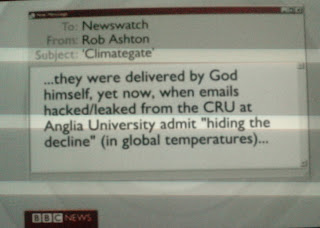
This is a propagandist's trick pretending to bend over backwards at being impartial (which we've seen before) . Rather than report facts, which could prove to be wrong, they are reporting concerns about their own bias , but concerns only from one side. Leaving the audience to conclude that the complainant has been wronged. It is a technique which leaves it's mark not just for what is said but for what is not said, because the clear implication is that there is something being held back. In the context of the timing it's difficult to see what the two skeptics could have complained about. Devoid of any contemporaneous gripe they instead recite the usual litany of (unchallenged) moans about the science and politics . At the time, the one thing that really needed to be established was the facts, instead the BBC gave us skeptic activists complaining not about facts but about their viewpoint .
Could it be that amongst the media frenzy of the first couple of weeks the broadcaster was unable to report any damning evidence from inchoate facts and in danger of falling behind it's competitors in the mainstream media. So a programme was done musing over whether the BBC itself was biased against the skeptics. As I can testify, the examination of bias is not an exact science, so if a broadcaster of the BBCs standing suggests it may itself be biased itself who's to argue?
One final point for now. Richard Black explains at some point about the BBCs impartiality document** which states that skeptics get less than half the 'space' . Yet there are only four people in the studio including the presenter (who is presumably unconvinced either way). Two of those are skeptics. There are no proponents of AGW apart from Black, and no one to defend the scientists at all. So that's 66% of the space going to the skeptics. Here we see the impartiality rules being explained to skeptics whilst ignoring the impartiality rules.
I find the deceipt going on by the commission of this programme to be deeply unsettling. I complain about BBC bias regularly. I have put in countless complaints this year, most of which have been completely ignored by the BBC. Yet here we see skeptic activists getting access to the airwaves only two weeks into the scandal to complain about nothing more than a percieved lack of speculation by the BBC, at a time when the only known fact was that the CRU had been hacked, which was of course a crime against the scientists.
** From SeeSaw to Wagon Wheel page 40
P.S. After many months three enquiries into the hacked emails cleared the scientists. The corresponding Newswatch programmes were broadcast on 9th April, 16th April and finally 10th July. But these programmes do not find time to mention the exoneration of the scientists.
Am working through the rest of the broadcasts. 23rd April is interesting, it's on science in general and contains an interview with Phallab Ghosh and one with the enigmatic Fiona Fox (director of the Science Media Centre and LM Group so she has a foot in both camps). Doesn't mention that the first enquiry was already in by then though.
The broadcast reports skeptical activists conspiracy theories at one point even adding words in to the emails to make a completely bogus point. An email is shown saying 'the CRU at Anglia University admit "hiding the the decline" (in global temperatures)' .
For the record the CRU do not admit any such thing and no hacked email says that either. This is an email sent to the BBC and the words in brackets have been added by a skeptic activist . Never let the truth get in the way of a good story! The University of East Anglia explained in late February in it's submission to Parliament exactly what the phrase "hide the decline" means, and it's not anything to do with global temperatures. So aren't the BBC jumping the gun here?
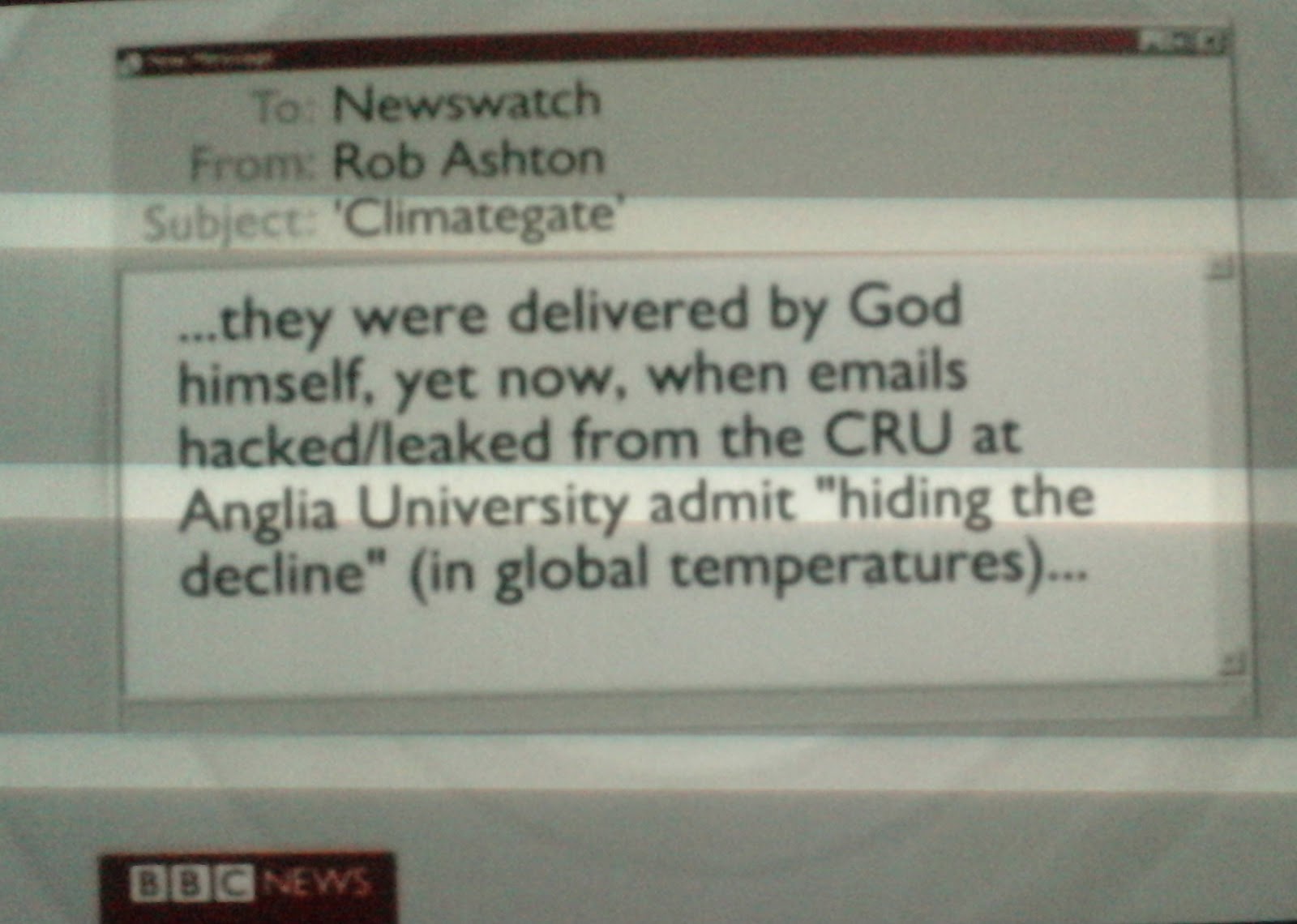
This is a propagandist's trick pretending to bend over backwards at being impartial (which we've seen before) . Rather than report facts, which could prove to be wrong, they are reporting concerns about their own bias , but concerns only from one side. Leaving the audience to conclude that the complainant has been wronged. It is a technique which leaves it's mark not just for what is said but for what is not said, because the clear implication is that there is something being held back. In the context of the timing it's difficult to see what the two skeptics could have complained about. Devoid of any contemporaneous gripe they instead recite the usual litany of (unchallenged) moans about the science and politics . At the time, the one thing that really needed to be established was the facts, instead the BBC gave us skeptic activists complaining not about facts but about their viewpoint .
Could it be that amongst the media frenzy of the first couple of weeks the broadcaster was unable to report any damning evidence from inchoate facts and in danger of falling behind it's competitors in the mainstream media. So a programme was done musing over whether the BBC itself was biased against the skeptics. As I can testify, the examination of bias is not an exact science, so if a broadcaster of the BBCs standing suggests it may itself be biased itself who's to argue?
One final point for now. Richard Black explains at some point about the BBCs impartiality document** which states that skeptics get less than half the 'space' . Yet there are only four people in the studio including the presenter (who is presumably unconvinced either way). Two of those are skeptics. There are no proponents of AGW apart from Black, and no one to defend the scientists at all. So that's 66% of the space going to the skeptics. Here we see the impartiality rules being explained to skeptics whilst ignoring the impartiality rules.
I find the deceipt going on by the commission of this programme to be deeply unsettling. I complain about BBC bias regularly. I have put in countless complaints this year, most of which have been completely ignored by the BBC. Yet here we see skeptic activists getting access to the airwaves only two weeks into the scandal to complain about nothing more than a percieved lack of speculation by the BBC, at a time when the only known fact was that the CRU had been hacked, which was of course a crime against the scientists.
** From SeeSaw to Wagon Wheel page 40
P.S. After many months three enquiries into the hacked emails cleared the scientists. The corresponding Newswatch programmes were broadcast on 9th April, 16th April and finally 10th July. But these programmes do not find time to mention the exoneration of the scientists.
Am working through the rest of the broadcasts. 23rd April is interesting, it's on science in general and contains an interview with Phallab Ghosh and one with the enigmatic Fiona Fox (director of the Science Media Centre and LM Group so she has a foot in both camps). Doesn't mention that the first enquiry was already in by then though.
Friday, 22 October 2010
BBC head honcho interviewed on Radio 4
The BBC announces new editorial guidelines that concern climate change. Science has been added to the list of controversial subjects, I gather . I haven't yet found the BBC's official announcement but the skeptics seem to think this will benefit them. David Jordan, Controller Editorial Policy is the author of the new guidelines and was interviewed by the esteemed Roger Bolton on Feedback, for the record here's what was said.
RB: Can I start by asking you... it is the attitude that producers should take to the question of climate change. Is it alright for a programme maker to proceed on the basis that climate change is occurring and it is largely man made?
DJ: The way we approach scientific controversy and indeed other controversies where there is a general consensus about something being the case is to say that we don't have to in every time we mention the issue have a balance of view one way or the other, in fact you can distort the debate if every time you talk about man made climate change you have somebody who either denies that it's happening at all or doesn't believe that it's man made. The important thing is that in our airwaves and in our coverage it's acknowledged that there are people who don't accept that there is man made climate change. They don't have to be part of every programme we make on the subject or be part of every discussion we do on the subject provided across our airwaves in general that view is reflected from time to time.
RB: You say they don't have to refer to the alternative view but do they have to critically question those who are saying that it is a proven reality?
DJ: It's appropriate for any report on those subjects to cross examine or question any assumptions that people may be making but it isn't necessary for the two different views always to be represented equally in any given programme.
RB: But no BBC programme should be a campaigning programme on an issue like this.
DJ: No. We don't do campaigning. We report
RB (interrupts) We shouldn't do but some of our listeners would think some programmes are campaigning.
DJ: We report campaigns and we shouldn't ever be campaigning on issues of this sort. Other than issues around broadcasting the BBC doesn't take sides and doesn't have a view.
RB; Can we move on to the new guidelines that you've just published. why are they needed, what has happened to make them necessary in your view?
DJ: Well, you know Roger, someone as long in the tooth as you are, knows that things change over the years we've had a lot of
RB: (interrupts) Principals don't change do they?
DJ: No the principals may not change hugely but the last one was produced in the wake of the Hutton Inquiry and the Gilligan affair, this one's being produced in the wake of some major editorial policy shocks, namely the telephony and interactivity issues, the issues over queengate and latterly the Brand Ross issue.
RB: Now you're extending the ideas of impartiality to a wider area. Theres an investigation by the Trust about the question of science and there's the issue of religion where you have at least in the view of the National Secular Society given further protection from offence to religious believers , have you done that?
(Interview continues on the subject of religion)
Wednesday, 13 October 2010
World Service only half biased
With comparative lightning speed the World Service's One Planet have responded to the point I made last week. It seems we have to follow the whole series to see impartiality. I was expecting an answer like that. This episode shows up how awkward it is to monitor the question of impartiality. Perhap's the Editor's response could be paraphrased as "this was only half biased." More thoughts to follow. Here's what he has to say:
Many thanks for your email, I always appreciate it when people take the time to write into the One Planet team.
I was aware that the interview with Professor Lindzen would open up the show to criticism from many people. But I do think it was right to speak with him. It's not often that we interview a climate change denier on the show (reflecting the fact that it remains a minority view among scientists), but it would be wrong of us to simply ignore the issue or pretend it doesn't exist. That does no one any favours as it fuels talk of conspiracies and cover ups. I believe it's much better to reveal the arguments being made on both sides, and allow listeners to make their
own choice. As you clearly have done.
I don't think anyone could accuse One Planet of giving equal time to those who do not believe in man-made climate change. And during the interview, Mike made a number of references to the fact that Professor Lindzen's view is in the minority. If - over the course of the One Planet series - you balance this show against the many other programmes which involve interviews with scientists, academics and politicians who strongly believe in the dangers posed by climate change, I believe One Planet offers a fair and impartial examination of the subject.
All the very best,
Steven
Steven Duke
Editor, One Planet
Friday, 8 October 2010
Response to BBC World Service 'One Planet' broadcast 3rd October featuring Dr Richard Lindzen
Most of this programme is given over to an interview with Dr Richard Lindzen who is clearly an opponent of the scientific consensus. The BBC's guide on impartiality in this field states :”the weight of evidence no longer justifies equal space being given to the opponents of the consensus. But these dissenters (or even sceptics) will still be heard, as they should, because it is not the BBC’s role to close down this debate. ” (From Seesaw to Wagon Wheel page 40)
There was nobody to rebut his assertions . It was not a debate . Dr. Lindzen's views were broadcast largely without criticism. In this programme the sceptics are clearly getting more than equal space. I suggest this is against the rules established for the BBC's impartiality.
Thursday, 30 September 2010
BBC misrepresented scientists behind empirical paper - Fact.
Have sent a follow up to my unanswered complaint about BBC Online's report of the Anderegg paper.
Hello, I sent a complaint about this article on August 9th and I have not received a reply. Paragraph 12 says that the motivations of the researchers was in part a response to 'recent scandals, such as "climategate" at the UK's University of East Anglia and the use of non-peer reviewed literature in the IPCC findings.' The press release from Stanford University does not cite these events, and I have to put it to you on that evidence alone the author of your report is speculating rather than quoting facts. But I have since been in touch with one of the authors of the scientific paper Mr Jim Prall of Toronto University * who states that Dr Anderegg contacted him in August 2009 and they began working on their paper the following month. It was not until November 2009 that the UEA emails were released . Ergo your reporter's speculations about the motivations behind this study amount to a factual error.
Needless to say, I also stand by my earlier remarks about your reporters sceptical commentary .
Or to put it more simply the BBC reporter made up the bits about motivations behind the paper, this can be proved by looking at the dates Anderegg and Prall had begun work on the paper.
So why am I so hot under the collar about this pissy little article? Well, it's about a very important scientific paper that could not be ignored, which gives empirical evidence for public understanding of climate science . The reporter is keen to present it as a 'he said she said' argument, when it is nothing of the sort. The report introduces what sceptics have to say in the third paragraph and concludes with the sceptics too. But the BBC report also suggests that the media bias is only as recent as , and limited to, the recent peccadilloes highlighted . The press release from Stanford University clearly suggests the paper is motivated by much wider and deeper frustrations.
"It is sad that we even have to do this," said the late Doctor Stephen Schneider. "[Too much of] the media world has just folded up and fired its reporters with expertise in science."
* Correpondence available in comments at http://birdbrainscan.blogspot.com/2009/07/great-climate-skeptics-swindle.html
UPDATE: Phoned BBC 15th November to chase it up, was given a reference number, was told I would get a reply in ten days.
UPDATE: Phoned BBC 6th December to chase it up, was given a reference number, was told I would get a reply in ten days.
P.S. And for those that want to see how a science article should be written, Martin Robbins of The Guardian helpfully provides a pro-forma.
Sunday, 5 September 2010
Manufacturing Ignorance
In "Manufacturing Consent" Noam Chomsky laments that the attention span of television news reporting is so short that only conventional thoughts can be expressed. Chomsky's brand of dissent is undermined by insufficient airtime, in the parlance of TV journalism it is called 'concision'. Global warming advocates are particularly susceptible to concision because of all the uncertainties and unravelling decades of misinformation . In short the unfolding narrative goes that the scientists present a dire prediction then the skeptical mass media ask how bleak? When the scientists express uncertainty the media move on. The effect is one of uncertain scientists rather than the bleak outlook.
This trick was skilfully played when Kirsty Wark on Newsnight (23rd August 2010) asked are the floods in Pakistan due to climate change? It's not a yes or no question, that unfortunately was posed as a yes or no question. Before we look at Newsnight's effort let's consider some informed opinion , here's Dr Kevin Trenberth on the subject:
Then there's Dr James Hansen who fairly observes essentially changing the climate is like loading a dice. A more unstable climate is more likely to give us extreme weather events and hence there will be more extreme weather events. But nailing a specific extreme weather event and asking if it is down to climate change is a different ball game*, and whilst the science, and effects of climate change are so hotly disputed one has to ask what purpose does Kirsty Wark's question serve?
Imagine you are in a casino and your suspicions lead you to say out loud that the roulette wheel might be loaded . And the croupier's response is to claim that the last spin might not have been different if the wheel weren't loaded; the sensible gambler should not find such a remark comforting and conclude it was time to give up.
Perhaps, when BBC producers commissioned this particular debate, they expected all critics to give up. So here's my two cents worth.
BBC news programmes habitually present climate related matters as two sided , a duel between skeptics and everyone else. For expert opinion the BBC chose Dr. Ghassem Asrar, a man with academic credentials in climate science as long as your arm who was cited as from the World Climate Research Project but is also from NASA. a doctor with membership of five professional societies and numerous awards was not enough for the BBC so they called on Andrew Montford a chartered accountant from Kinross. An odd choice for the question at hand because Montford's credentials are that he cannot agree on what the climate has been over the last millenium. Montford largely agreed with the eminent doctor, so was he on the programme for balance or for concision?
A chilling theme of the debate was that now that climate change is upon us, mitigation is obsolete and the question becomes how to adapt.Wark suggested proacive work be done in the form of local levees. But carbon was not mentioned once. The word mitigate was used only once, by Montford, erroneously or mendaciously suggesting that local adaptive measures were mitigation.
The consensus inevitably reached was that you can't say that these particular floods in Pakistan are due to climate change. But that is due to the 'crooked croupier's proposition' given above. Never did they mention the caveat that the extreme weather events we are beginning to witness now are just the kind of thing scientists would expect in a global warming world .
For no good reason at the end of the debate Wark asked after climategate are scientists becoming more cautious in pronouncing on what could be aspects of global warming? Montford was asked "do you accept climate change is a grave risk facing us all," to which he blustered "errm from my perspective I think the answer is I don't know. I think mankind is affecting the climate but whether it's a little or a lot , I think , in reality we really just don't know"
'We really just don't know' is the so called informed opinion they would like to leave you with on climate change. You've got to hand it to those folks at the BBC - they are skilled propagandists. Wark deserves particular opprobrium for fronting this angle, which seems trivial with two million homeless and thousands dead . Of course it's anything but trivial , such is the twisted nature of the media's reporting of our changing climate.
* A sensible discussion of the question is offered by Michael Tobis in 'When it Rains it Pours'
This trick was skilfully played when Kirsty Wark on Newsnight (23rd August 2010) asked are the floods in Pakistan due to climate change? It's not a yes or no question, that unfortunately was posed as a yes or no question. Before we look at Newsnight's effort let's consider some informed opinion , here's Dr Kevin Trenberth on the subject:
“I find it systematically tends to get underplayed and it often gets underplayed by my fellow scientists. Because one of the opening statements, which I’m sure you’ve probably heard is “Well you can’t attribute a single event to climate change.” But there is a systematic influence on all of these weather events now-a-days because of the fact that there is this extra water vapor lurking around in the atmosphere than there used to be say 30 years ago. It’s about a 4% extra amount, it invigorates the storms, it provides plenty of moisture for these storms and it’s unfortunate that the public is not associating these with the fact that this is one manifestation of climate change. And the prospects are that these kinds of things will only get bigger and worse in the future.”
Then there's Dr James Hansen who fairly observes essentially changing the climate is like loading a dice. A more unstable climate is more likely to give us extreme weather events and hence there will be more extreme weather events. But nailing a specific extreme weather event and asking if it is down to climate change is a different ball game*, and whilst the science, and effects of climate change are so hotly disputed one has to ask what purpose does Kirsty Wark's question serve?
Imagine you are in a casino and your suspicions lead you to say out loud that the roulette wheel might be loaded . And the croupier's response is to claim that the last spin might not have been different if the wheel weren't loaded; the sensible gambler should not find such a remark comforting and conclude it was time to give up.
Perhaps, when BBC producers commissioned this particular debate, they expected all critics to give up. So here's my two cents worth.
BBC news programmes habitually present climate related matters as two sided , a duel between skeptics and everyone else. For expert opinion the BBC chose Dr. Ghassem Asrar, a man with academic credentials in climate science as long as your arm who was cited as from the World Climate Research Project but is also from NASA. a doctor with membership of five professional societies and numerous awards was not enough for the BBC so they called on Andrew Montford a chartered accountant from Kinross. An odd choice for the question at hand because Montford's credentials are that he cannot agree on what the climate has been over the last millenium. Montford largely agreed with the eminent doctor, so was he on the programme for balance or for concision?
A chilling theme of the debate was that now that climate change is upon us, mitigation is obsolete and the question becomes how to adapt.Wark suggested proacive work be done in the form of local levees. But carbon was not mentioned once. The word mitigate was used only once, by Montford, erroneously or mendaciously suggesting that local adaptive measures were mitigation.
The consensus inevitably reached was that you can't say that these particular floods in Pakistan are due to climate change. But that is due to the 'crooked croupier's proposition' given above. Never did they mention the caveat that the extreme weather events we are beginning to witness now are just the kind of thing scientists would expect in a global warming world .
For no good reason at the end of the debate Wark asked after climategate are scientists becoming more cautious in pronouncing on what could be aspects of global warming? Montford was asked "do you accept climate change is a grave risk facing us all," to which he blustered "errm from my perspective I think the answer is I don't know. I think mankind is affecting the climate but whether it's a little or a lot , I think , in reality we really just don't know"
'We really just don't know' is the so called informed opinion they would like to leave you with on climate change. You've got to hand it to those folks at the BBC - they are skilled propagandists. Wark deserves particular opprobrium for fronting this angle, which seems trivial with two million homeless and thousands dead . Of course it's anything but trivial , such is the twisted nature of the media's reporting of our changing climate.
* A sensible discussion of the question is offered by Michael Tobis in 'When it Rains it Pours'
Monday, 9 August 2010
Falsehoods and bias in BBC Science report
On 24th June BBC online published "Study examines scientists 'climate credibility'" , in response to a carefully thought out empirical paper on scientific expertise in climate science. It was an important paper as the press release from Stanford University shows. Read the press release then read the BBC's article and see if you think the BBC's article is fair. Here is my complaint, sent August 9th 2010:
I have compared the Stanford Press Release to your article and have to say that the claim you make in paragraph 12 is false if it is based on that press release.
Please could you cite your source for the claim that the Anderegg study was a response to the specific recent scandals you refer to.
This article breaks the story of one of the most important scientific papers published recently for public understanding of Climate Change. You say “Sceptical groups, however, argued that publication in scientific journals was not a fair test of expertise.” That is not a view being honestly held or coherently expressed because no alternative measure is offered.
Your suggestion that Dr Sonja Boehmer-Christiansen is an impartial observer is false. She is a founder of a pressure group called the “Scientific Alliance” which recieves funds from the mining industry, Whilst Dr Sonja Boehmer-Christiansen is from the University of Hull, she is an Emeritus Reader in geography, therefore retired. Her criticisms of Anderegg et al would have to apply to herself if you were being even handed.
Concluding your article with her quote “that the authors belong to an IPCC supporting group that must count as believers and belong to the beneficiaries of the man-made warming scare” is biased . Such a statement deserves to be investigated if true. It can be investigated as I demonstrate in the above paragraph , and I have found that this article is manufacturing a controversy to suit industry and special interest groups.
Thursday, 5 August 2010
Stage 2 of the BBC complaints process
Here is the response to Stefan Curran, sent 9th August 2010
Dear Stefan,
Thank you very much indeed for your undated letter.
In addition to my letter (of February 5th ) I sent the BBC a number of emails through the internet complaints portal. However I 'phoned the complaints department the day I received your letter and they confirmed that your letter is also a response to all of those emails. You have not addressed the points I made in my emails sent on or around 15th February about editorial guidelines on impartiality and personal view.
I also emailed on 21st February an assertion that sections 7.9 and 7.13 of the Broadcasting Code had been breached. I even received a response from Alec Mackenzie on the 28th February promising a substantive reply. I have to take your letter as an indication that the BBC complaints department is now backtracking on that position. And I must express shock that the BBC ignores accusations of stepping outside OFCOM's rules. On June 8th I emailed to point out that Ms Townsend was unwilling to substantiate or clarify her claim about the “200 environmentalists”. I have repeatedly asked for identification of the 200 environmentalists (most recently on 8th June by email) and the BBC's response has been highly unstatisfactory. Ms Townsend's assertion about the motivations of such individuals has not been scrutinized by the programme makers and does not stand up to scrutiny after the event.
I put it to you again that OFCOM section 7.9 demands that the BBC be able to determine whom Ms. Townsend was referring to, and also demands that an offer to contribute to such persons or organization was made. And that in the absence of that, sections 7.9 and 7.13 have been breached.
I have to suggest that your assertion that the title of the programme was posing a question rather than asserting a point of view is dishonest. As a linguistic construction it was a question, but not one that the programme made any attempt to answer. The title of a documentary is clearly an indicator of a point of view.
Thank you for disclosing the original intention of the programme. I take that as an indication that the bias displayed by Mr Rowlatt was inherited when the documentary was conceptualized, which he has chosen to amplify rather than moderate.
I have to say that I find point (i) very disturbing. An evaluation of what is really justified requires full understanding of the magnitude of the problem, we simply don't have that. By suggesting that some proposals can be dismissed as not really justified, the programme downplays the problem.
I should point out that all informed commentators know that there is a wide gulf between climate science and the public's view of climate change. The climate change problem is a hotly contested issue which many people deny altogether, there is a considerable degree of public confusion and unscientific skepticism about this issue which, I might add, the BBC has played a part in disseminating. This documentary proceeded as if that context did not exist, that the threat of anthropogenic climate change had somehow instilled a shared set of values upon which environmentalists infringe. In essence this documentary has turned reason on it's head.
Turning to point (ii) this documentary produced an argument to that effect without producing any evidence . There was no examination whatsoever of the profile or rationale or numbers of people who were taking climate change less seriously than they might.
We have a vague reference at the end when Mr Rowlatt refers to “many people” but he simply ploughs on to his conclusion that solutions being proposed will serve to confirm scepticism. Whilst there may be some truth in that, he offers no caveat that such an approach is irrational, unscientific,illogical and biased. The listener is left with a false impression that such thinking is reasonable. I put it to you that this is not impartial and is indeed identified in the BBC Trust's guidance on this, which sees causation and solution as separate debates . I am sure we would both agree there is great wisdom in the BBC Trust's approach, which states that it “is not the job of the BBC to close down [the causation] debate”. Likewise it is not the job of the BBC to enflame the causation debate with arguments from the solution debate. This documentary set out to conflate these debates in order to reach a conclusion which is neither honest nor rationally held.
I urge you to please reconsider the position of the BBC. The best course of action would be for the BBC to admit that this broadcast was ill-concieved. That it was unfair from the outset, and that as an investigation it was a sham.
My best wishes and,
Salutations,
Hengist McStone
P.S. You may be interested that I develop my thoughts publicly on this at http://bbcantigreenbias.blogspot.com/
Friday, 2 July 2010
There is only one Bjorn Lomborg
On Monday 28th June BBC Panorama broadcast a documentary entitled "Whats UP With the Weather". A pun that will be not lost on climate geeks. To some extent it moved on the debate but only on carefully controlled terms dominated by the near certainties of anthropogenic climate change. There was nothing new in this programme except that towards the end we were treated to a fleeting moment of the long overdue adaptation/mitigation debate. And for the skeptics the BBC called on, a man who needs no introduction : Bjorn Lomborg . One might ask : Why does the BBC invite the climate skeptics to answer the question derived from their misplaced skepticism ?
The subtext here is AGW is happening but the same old faces are going to get in the way of any serious mitigation. It's a bit like asking the head of Philip Morris if he can reccomend a cure for cancer now.
What is so tragic is that the average TV audience's credentials are better than Lomborg's because he has been wrong for too long . Most people haven't had their knuckles rapped by a national scientific institution. Most people haven't been pretending to be climate scientists when their doctorate is political science - specifically, game theory . Most people do not have a website dedicated to their errors! Or a book dedicated to their deceipt !
Yet the BBC ask Lomborg to pontificate on the moral question of which is the worst cassandra .**
The BBC Trust's view is this : "The BBC has held a high-level seminar with some of the best scientific experts, and has come to the view that the weight of evidence no longer justifies equal space being given to the opponents of the consensus. But these dissenters (or even sceptics) will still be heard, as they should, because it is not the BBC's role to close down this debate. Acceptance of a basic scientific consensus only sharpens the need for hawk-eyed scrutiny of the arguments surrounding both causation and solution." *
But Hengist McStone suggests BBC programme makers are conflating causation and solution . The point at which the Adaptation vs. Mitigation debate was reached is surely where Doctor Lomborg has to leave the stage. He has been given a platform on the BBC for at least as long as The Skeptical Environmentalist was first published by CUP. Since then the science has moved on considerably to present a more urgent and a more clear and a more catastrophic scenario.
* From SeeSaw to Wagon Wheel page 40
**Lomborg advocated a projection that sea level rises where predicted to be only thirty centimetres this century, it is the lowest figure this writer has ever heard , it was unchallenged . Further reading try Joe Romm or for a less confrontational view try the eminent and entertaining Doctor Michael Tobis
Subscribe to:
Posts (Atom)